What is a tummy tuck?
A tummy tuck, or abdominoplasty, reshapes the abdomen by removing loose skin and fat and, in most cases, tightening the abdominal muscles and the tough layer of tissue that covers them. It is not a weight loss operation. It treats the things that diet and exercise cannot change, such as overhanging skin after pregnancy or major weight loss, stretch marks below the navel and muscles that have drifted apart down the middle (diastasis recti).
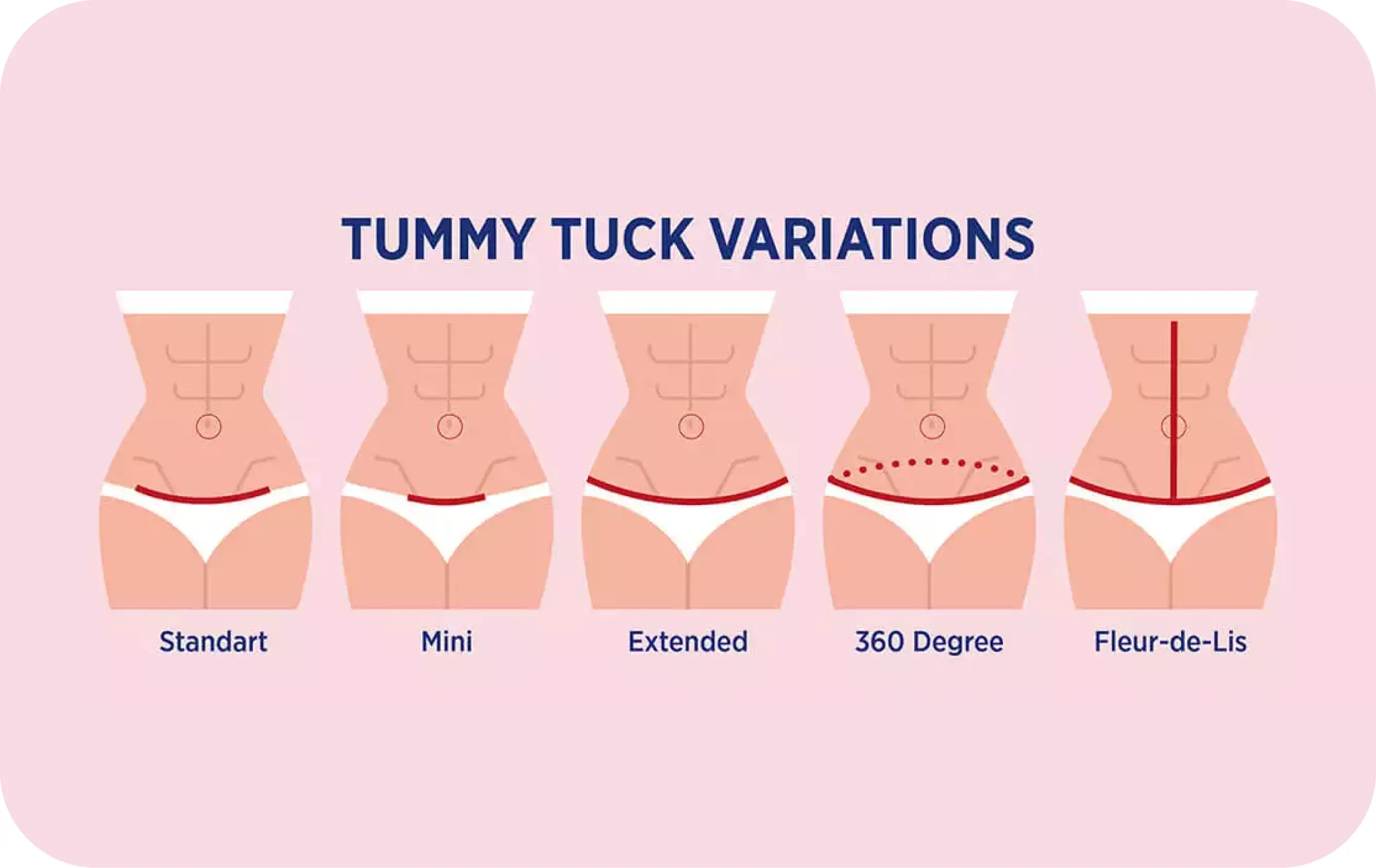
Because the amount and position of loose skin differ so much from person to person, surgeons use several variations of the operation. They differ mainly in the length and position of the scar, whether the belly button is repositioned and which part of the abdomen is treated.
Who is a tummy tuck suitable for?
You may be a good candidate if you:
- Have loose or overhanging skin on the abdomen, particularly below the belly button
- Have weak or separated abdominal muscles after pregnancy
- Have fat or stretch-marked skin that has not improved with weight loss
- Have a BMI below 30 and a stable weight
- Are healthy enough for general anaesthesia
- Are not planning further pregnancies or major weight loss
Smoking slows healing considerably, so you will need to stop well before surgery. If you are still losing weight, it is usually better to wait until your weight has been steady for several months.
Types of tummy tuck
Full (standard) tummy tuck
This is the most common version. A low incision runs between the hip bones, just above the pubic area, with a second small incision around the belly button. The surgeon tightens the muscles, removes the excess skin and fat and draws the remaining skin down. It suits people with loose skin both above and below the navel.
Mini tummy tuck
A shorter incision, similar to a caesarean section scar, is used to treat only the area below the belly button, which stays where it is. It removes the least tissue and suits a small pouch low on the abdomen. An existing caesarean scar can often be removed at the same time.
Extended tummy tuck
The scar is longer and runs from hip to hip, curving slightly onto the flanks. As well as treating the whole front of the abdomen, it tightens the love handles and can smooth the upper outer thighs. It is often chosen after significant weight loss.
Reverse tummy tuck
This variation targets loose skin above the belly button. The incisions sit in the fold beneath the breasts, and the skin is lifted upwards rather than pulled down. It is less common and suits a specific pattern of upper abdominal laxity.
Liposuction is often combined with any of these to refine the waist. If loose skin wraps all the way around to your back, a lower body lift may be the better option.
How the operation is done
All types are usually carried out under general anaesthesia. A mini tummy tuck takes about 1 to 2 hours, while a full or extended one takes 2 to 4 hours.
Assessment and marking
You arrive at the hospital the day before surgery for blood tests and an ECG. The surgeon examines and measures your abdomen, confirms the type of tummy tuck, takes photographs for your records and draws the incision lines while you stand.
Lifting the skin
Through the planned incision, the skin and fat are separated from the muscle wall up towards the ribs, or only as far as the navel in a mini tummy tuck.
Repairing the muscles
Where the muscles have separated, they are stitched back together down the midline with strong sutures, giving a flatter and firmer wall.
Removing the excess and closing
The skin is drawn tight and the excess is trimmed away. In a full or extended tummy tuck the belly button is brought out through a new opening. The wound is closed in layers, and thin drains may be placed to stop fluid collecting.
Recovery timeline
- First 1–2 days
You will feel tight and sore, and you will walk slightly bent at the waist. Getting up and walking early helps circulation. You stay in hospital for 4 nights.
- Week 1
You rest in hospital, attend a check-up and usually have any drains removed before flying home on day 5.
- Weeks 2–3
You gradually stand straighter and most people return to desk work.
- Weeks 4–6
You keep wearing the compression garment. Avoid heavy lifting and strenuous exercise until about six weeks.
- Months 3–12
Swelling continues to settle and the scar slowly flattens and fades from pink to a paler line.
Aftercare
- Wear the compression garment day and night for about 4 to 6 weeks
- Sleep with your upper body raised and knees bent for the first couple of weeks
- Avoid aspirin, ibuprofen and similar medicines for two weeks before and after surgery unless your surgeon says otherwise
- Do not smoke while you heal
- Keep the scar out of the sun for at least a year
- Follow the wound-care instructions and attend every check-up
Risks and side effects
A tummy tuck is a significant operation. Your surgeon will explain the risks before you consent. They include:
- Bleeding or a collection of blood (haematoma)
- Fluid collection under the skin (seroma)
- Infection
- Slow wound healing, particularly at the centre of the scar
- Blood clots in the legs or lungs
- Numbness of the lower abdomen, which can be long-lasting
- A wide or raised scar, asymmetry or small bulges at the ends of the scar
- Reactions to anaesthesia
Stopping smoking, walking early and wearing the garment all reduce these risks.
Results
You will see a flatter abdomen straight away, although swelling hides the final shape for several months. Results are long-lasting as long as your weight stays stable, though ageing and future pregnancy can loosen the skin again. The scar is permanent but usually fades well and sits low enough to be covered by underwear.
Tummy tuck in Turkey: your trip
Before you fly
You send photographs and your medical history so the surgeon can suggest a likely type. Stop smoking and drinking alcohol at least two weeks before surgery, stop multivitamins a week before and stop the contraceptive pill about 30 days before, after checking with your doctor.
In Istanbul
A VIP driver meets you at the airport, and a translator stays with you through tests, consultations and discharge. A companion can stay with you at no extra cost, and your hospital stay, meals and medication are included.
Back home
Your coordinator stays in touch 24/7 on WhatsApp, checks on your wound and swelling from photos and passes any concerns to the surgical team.
What the Tummy Tuck Variations package includes
- VIP transfers from and to Istanbul Airport (IST)
- Fully equipped room in the hospital
- Translation services at the hospital and during follow-up
- Pre-operative testing
- Consultation with your doctors
- Post-operative care and follow-ups for a year
- General anaesthesia
- Special compression garments
- One companion included in the price
- Three meals a day for you and your companion
- Full hospital stay for 4 nights, 5 days
- Aftercare package with a full set of medications to take home
Tummy Tuck Variations FAQ
Which type of tummy tuck is right for me?
It depends on where your loose skin is and how much there is. A small pouch below the navel may only need a mini tummy tuck, while loose skin above and below the navel usually needs a full one, and excess that wraps onto the hips suits an extended tummy tuck. The surgeon confirms the type after examining you in person.
How big is the scar?
A mini tummy tuck leaves a scar similar to a caesarean section scar. A full tummy tuck runs roughly from hip bone to hip bone, and an extended one continues onto the flanks. All are placed low so that underwear or swimwear usually covers them.
Will my belly button look different?
In a full or extended tummy tuck the belly button stays attached to its stalk and is brought out through a new opening in the tightened skin, so it looks natural once healed. In a mini tummy tuck it is not moved.
Can I combine a tummy tuck with liposuction?
Yes. Liposuction of the flanks or abdomen is often added to refine the waistline. Your surgeon will decide how much can be done safely in one operation.
Can I have children after a tummy tuck?
Pregnancy is possible, but it can stretch the skin and separate the muscles again. Most surgeons advise waiting until you have finished having children.
How long do I need to stay in Istanbul?
Plan for 5 days in Istanbul. Your package includes a full hospital stay of 4 nights, so you recover in a private room with nurses on hand day and night. You have a check-up and drain removal before you fly home.
When can I go back to work?
Most people return to desk work after 2 to 3 weeks. Jobs that involve lifting or physical effort usually need 6 weeks.