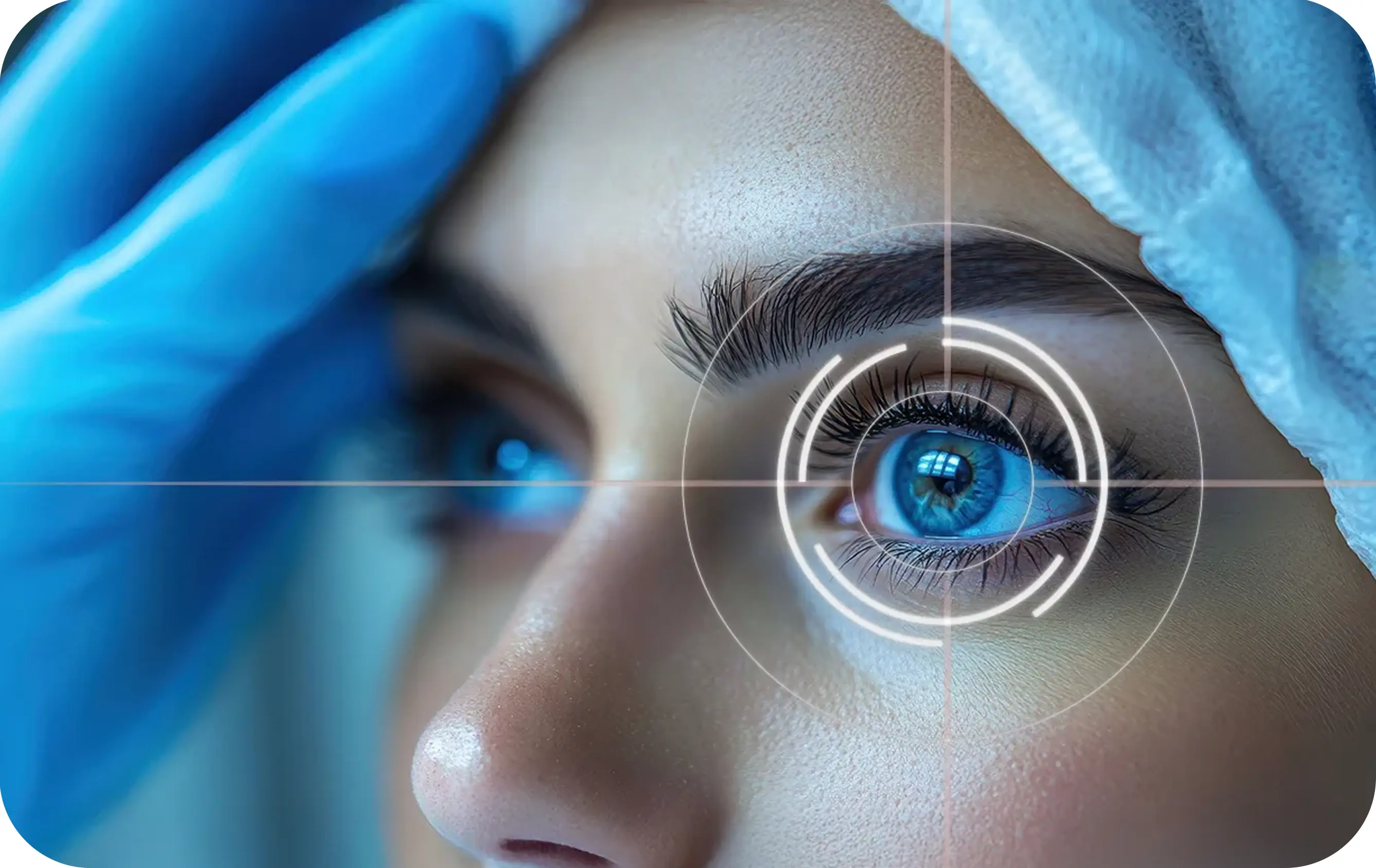
What is LASIK eye surgery?
LASIK stands for laser-assisted in situ keratomileusis. It is a type of laser vision correction that changes the curve of the cornea, the clear window at the front of the eye. When the cornea is the wrong shape, light focuses in front of or behind the retina, or unevenly, and your vision blurs. Reshaping it with a laser lets light focus correctly, so you can see clearly without glasses or contact lenses.
LASIK treats short sight (myopia), long sight (hyperopia) and astigmatism. Some customised forms also reduce glare and halos and improve contrast in low light. In modern bladeless LASIK, one laser creates a very thin flap on the surface of the cornea and a second laser, the excimer laser, reshapes the tissue beneath it. The flap is then laid back down and seals on its own, without stitches.
Who is LASIK suitable for?
Your ophthalmologist decides after detailed tests, but LASIK usually suits people who:
- Are adults, usually in their 20s to 40s, with a prescription that has been stable for at least a year
- Have corneas that are thick enough and normally curved
- Do not have keratoconus, raised eye pressure or other eye disease
- Do not have conditions that affect healing, such as poorly controlled diabetes or some autoimmune diseases
- Are not pregnant or breastfeeding
If you are over 40 and your main problem is reading, lens replacement may be a better option, because LASIK does not correct the stiffening of the lens that comes with age.
Types of laser eye surgery
LASIK and iLASIK
Standard bladeless LASIK uses a femtosecond laser for the flap. iLASIK combines a bladeless flap with a treatment guided by a detailed map of your eye. It is one of the most widely used forms of laser correction.
Wavefront-guided LASIK
Software measures how light travels through your eye and creates a map of its fine irregularities. The laser follows this map, which can help with higher astigmatism, glare, halos and poor night vision.
PRK
Photorefractive keratectomy reshapes the surface of the cornea after the thin outer layer of cells is gently removed. There is no flap, so it suits people whose corneas are too thin for LASIK. A protective contact lens is worn for about five days while the surface heals, and recovery takes longer.
How the procedure is done
Tests and consultation
You arrive the day before treatment for a full eye examination, including mapping of the cornea, thickness measurements and eye pressure. The ophthalmologist confirms which treatment suits you and explains it.
Numbing and positioning
Numbing drops are placed in your eye and a small holder keeps your eyelids open. You lie under the laser and look at a target light.
Creating the flap
The femtosecond laser creates a thin flap, which the surgeon gently folds back. You may feel pressure and your vision will dim for a few seconds.
Reshaping the cornea
The excimer laser reshapes the cornea in a few seconds to a minute, tracking small eye movements as it works.
Replacing the flap
The flap is smoothed back into place and the eye is checked. The second eye is then treated in the same way.
Recovery timeline
- First few hours
Blurred vision, watering, light sensitivity and stinging are common. Resting with your eyes closed helps. A night in hospital is available if you would like it.
- Day 1
Your surgeon checks your eyes. Many people already see well enough to watch television and read.
- Days 2–4
Vision continues to sharpen. Most people return to work and driving after 3 to 4 days.
- Weeks 1–4
Dryness and some glare at night are common and usually ease as the eye heals.
- Months 1–3
Vision stabilises. After PRK, this process takes longer than after LASIK.
Aftercare
- Use the antibiotic and steroid drops as prescribed, and lubricating drops for about 3 to 6 months
- Do not rub, touch or wash your eyes for the first 24 hours, and wear the shields at night as advised
- Keep soap, shampoo and dust out of your eyes
- Avoid eye make-up for about a week, and swimming and contact sports for at least two weeks
- Use painkillers that do not thin the blood, such as paracetamol, if needed
- Wear sunglasses outdoors
Risks and side effects
LASIK is one of the most studied elective procedures, and serious problems are uncommon. Possible side effects include:
- Dry, gritty or itchy eyes, which usually improve over months
- Glare, halos or starbursts around lights at night
- Watery eyes, stinging or discomfort for the first few days
- Under- or over-correction, which may need a top-up treatment or glasses
- Double vision or blurred vision, usually temporary
- Flap problems or infection, which are rare
- Gradual weakening and bulging of the cornea (ectasia), which is very rare
Results
Most people achieve vision that lets them drive and go about daily life without glasses or contact lenses. The reshaping is permanent, although your eyes can still change with age, and reading glasses are likely to be needed from middle age.
LASIK in Turkey: your trip
Before you fly
Send your latest eye report or topography scan and your prescription. Stop wearing soft contact lenses for about a week before your tests, and hard lenses for longer, as advised.
In Istanbul
A VIP driver meets you at the airport and takes you to your hotel. A translator is with you for tests and treatment, a companion can stay at no extra cost, and transfers, meals and medication are included.
Back home
Your coordinator is available 24/7 on WhatsApp. An optician can carry out routine checks, and any concerns are passed straight to your surgeon.
What the LASIK Eye Surgery package includes
-
Hospital and medical care
Your private hospital room, nursing care, pre-operative tests, consultations with your surgeon, anaesthesia, the operation itself and the medication you take home.
-
VIP transfers
A private driver meets you at the airport and takes you between the airport, your hotel and the hospital.
-
Translator and companion
A medical translator at the hospital, and a companion can travel with you at no extra cost.
-
Meals and comfort
Daily meals for you and your companion throughout your stay.
-
24/7 patient coordinator
A dedicated coordinator answers your questions before, during and after your trip, in your language.
LASIK Eye Surgery FAQ
Am I suitable for LASIK?
You are more likely to be suitable if you are an adult with a prescription that has been stable for at least a year, corneas of good thickness and shape, and no eye disease such as keratoconus or glaucoma. Full tests in Istanbul confirm whether LASIK, PRK or another option suits you best.
Does LASIK hurt?
Numbing drops mean you feel pressure rather than pain during treatment. For a few hours afterwards your eyes may sting, water or feel gritty, and simple painkillers and rest usually help.
What is the difference between LASIK and PRK?
LASIK creates a thin flap in the cornea and reshapes the tissue underneath, so recovery is quick. PRK reshapes the surface directly with no flap, which suits thinner corneas, but healing is slower and more uncomfortable for the first few days.
Will I need reading glasses later?
LASIK corrects your distance prescription but does not stop the natural ageing of the lens. Most people start to need reading glasses in their 40s or 50s whether or not they had laser surgery.
How soon can I fly home?
Most patients fly home after their check on the day after treatment or a day later. Use your lubricating drops during the flight, as cabin air is dry.
When can I drive and return to work?
Most people can go back to work and drive after 3 to 4 days, once the surgeon confirms your vision meets the legal standard for driving.
Can the result change over time?
The correction is permanent, but a small number of people find that their eyes drift slightly over the years. If there is enough corneal tissue, a top-up treatment may be possible.