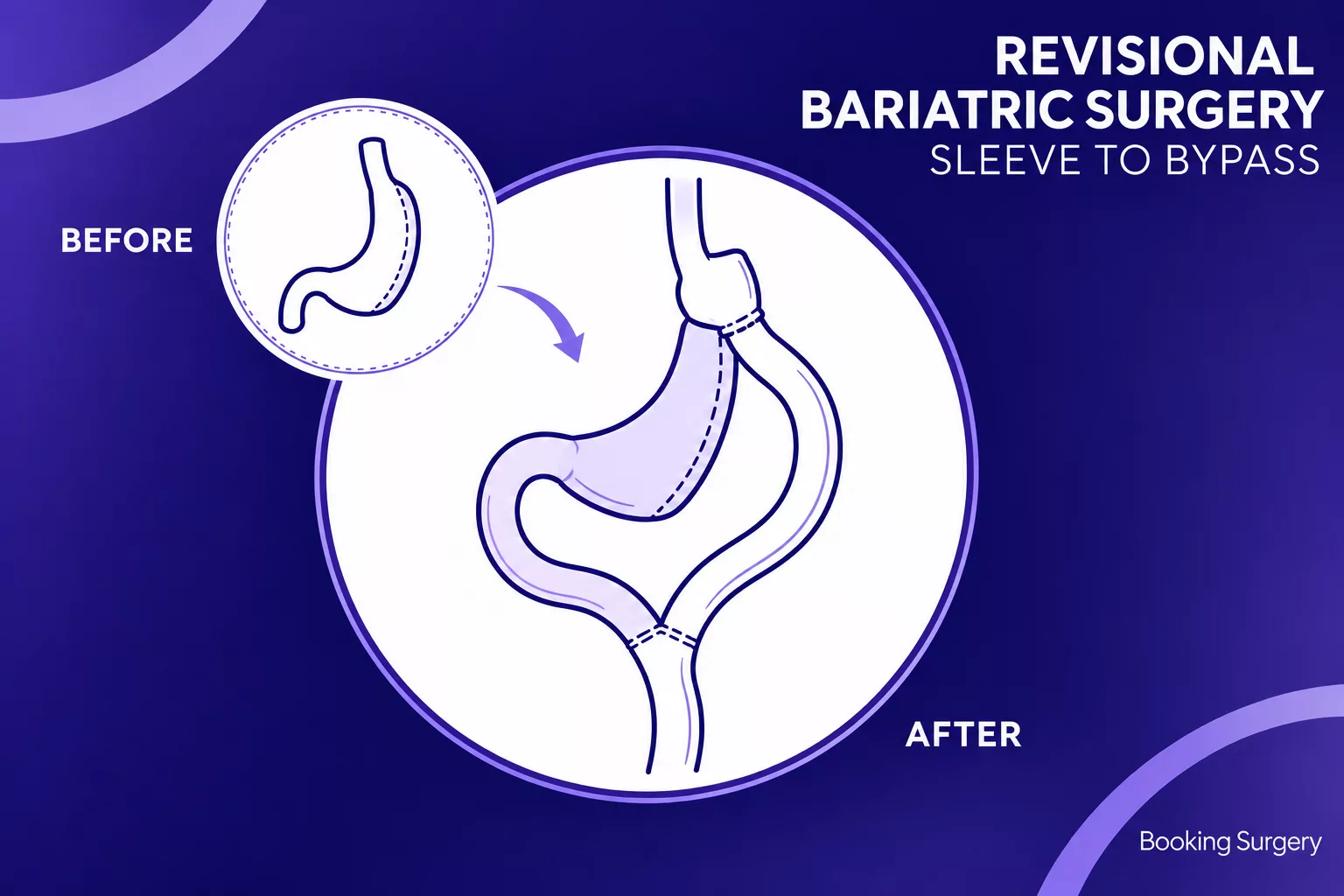
What is revisional bariatric surgery?
Revisional bariatric surgery is an operation to repair, adjust or replace a weight loss procedure you have had before. The earlier operation might be a gastric band, a gastric sleeve, a Roux-en-Y gastric bypass or a mini gastric bypass. Most people do well after their first operation, but for some the weight loss is smaller than hoped, the weight slowly returns, or side effects develop that medicine cannot control.
A revision is described by two things: the operation you already have and the one it becomes. A sleeve can be reshaped into a narrower sleeve or converted to a bypass, for example. Once the revision is complete, it works in the same way as the procedure you have been converted to, and the expected weight loss is broadly similar, although results vary more from person to person.
Who is it suitable for?
Revision may be worth considering if you:
lost less weight than expected after your first operation
have regained a significant amount of weight
have a band that has slipped, eroded, leaked or caused swallowing problems
have developed severe acid reflux after a sleeve that does not settle with medication
have a stomach pouch or sleeve that has stretched over time
are in good enough health for general anaesthesia and are ready to commit to the diet again
Regaining weight is not always a surgical problem. Before recommending an operation, the team looks at your eating habits, your tests and the anatomy of your earlier surgery to make sure a revision is likely to help.
Types of revision
Sleeve to sleeve (re-sleeve)
If the sleeve has widened, the surgeon can trim it back to a narrower tube. This restores the sense of fullness and can restart weight loss. How much you lose depends partly on how much weight you regained.
Gastric band to another procedure
Because a band does not cut or reroute the stomach, there are usually several options. After the band is removed, you may be able to have a sleeve, a mini gastric bypass or a Roux-en-Y bypass, done much as it would be as a first operation. In some cases the band is removed first and the second operation follows later.
Sleeve to gastric bypass
This is one of the most common conversions. It is often chosen when the sleeve has left too much stomach or when reflux has become a problem. The bypass usually improves reflux and adds a further effect on weight.
Bypass to bypass
A bypass has two parts that can be adjusted: the stomach pouch and the length of intestine that food skips. An endoscopy is done beforehand to measure the pouch. The surgeon may make the pouch smaller and, where suitable, lengthen the bypassed section of intestine.
How the procedure is done
Preparation at home
You stop smoking at least a week before surgery and for at least three weeks afterwards, and avoid alcohol in the weeks before, especially the final week. Hormonal contraception containing oestrogen is usually stopped about four weeks beforehand. Tell the team about every medicine and supplement you take, as some affect bleeding or clotting.
Tests and consultations in Istanbul
You have blood tests, an abdominal ultrasound, a chest X-ray, breathing tests, an ECG and an endoscopy. You meet the surgeon, the anaesthetist, an internal medicine specialist and, where needed, a radiologist. You must not eat or drink for about 12 hours before surgery.
The operation
The surgery is done by keyhole surgery under general anaesthesia. The surgeon first frees any scar tissue, then reshapes or converts the earlier procedure. Revisions take longer than first operations, usually 2 to 4 hours.
Checking for leaks
Staple lines and joins are tested before the small incisions are closed.
Recovery timeline
- First 24 hours
You are monitored closely and helped to walk within a few hours. Pain relief, fluids through a drip and blood-thinning injections are given.
- Days 2–5
Once the team is satisfied, you start sips of clear liquid. Most patients are discharged to the hotel after 4 nights, or after 2 nights when only a gastric band is removed.
- Weeks 1–4
You stay on liquids and then puréed food. Tiredness is normal. Many people return to desk work after 3 to 4 weeks.
- Months 2–18
You move to soft and then normal textures in small portions. Weight loss is usually fastest in the first six months.
Aftercare
follow the staged diet and aim for at least 60 g of protein a day
take the vitamin and mineral supplements prescribed, which after a bypass are needed for life
wear compression stockings and take blood thinners as instructed
avoid sugar, alcohol and fizzy drinks in the early months
have regular blood tests to check for deficiencies
Risks and side effects
Because of scar tissue and altered anatomy, revision surgery carries a higher risk than a first operation. Possible problems include:
leaks from staple lines or joins
bleeding and infection
blood clots in the legs or lungs
narrowing or blockage at a join
ulcers and internal hernia after a bypass
vitamin and mineral deficiencies
less weight loss than hoped
Results
Most patients start losing weight again within the first months. The final result usually becomes clear by 12 to 18 months and depends heavily on the eating habits you build. Reflux after a sleeve often improves after conversion to a bypass.
Revisional bariatric surgery in Turkey: your trip
Before you fly
Send details of your first operation, your weight history, symptoms and any recent scans or endoscopy reports. The surgeon reviews them and you receive a treatment plan and price.
In Istanbul
A driver meets you at the airport. Your hospital stay, tests, surgery, medication and meals are included, a translator supports you throughout, and a companion can stay at no extra cost.
Back home
Your coordinator is available 24/7 on WhatsApp, follows your diet stages and passes any questions to the surgical team.
What the Revisional Bariatric Surgery package includes
-
Hospital and medical care
Your private hospital room, nursing care, pre-operative tests, consultations with your surgeon, anaesthesia, the operation itself and the medication you take home.
-
VIP transfers
A private driver meets you at the airport and takes you between the airport, your hotel and the hospital.
-
Translator and companion
A medical translator at the hospital, and a companion can travel with you at no extra cost.
-
Meals and comfort
Daily meals for you and your companion throughout your stay.
-
24/7 patient coordinator
A dedicated coordinator answers your questions before, during and after your trip, in your language.
Your surgeons for Revisional Bariatric Surgery


Revisional Bariatric Surgery FAQ
Why might my first weight loss operation need revising?
Common reasons are not losing enough weight, regaining weight over time, or developing a problem such as severe reflux, difficulty swallowing, a slipped or damaged band, or a stomach pouch that has stretched. Sometimes the body simply responds less well to one type of operation than expected.
Which revision will I be offered?
That depends on your first operation, your current weight, your symptoms and the results of an endoscopy and other tests. A band may be replaced by a sleeve or bypass, a sleeve may be re-sleeved or converted to a bypass, and a bypass may have its pouch or limb lengths adjusted. The surgeon explains the options that are safe for you.
Is revision surgery riskier than the first operation?
Yes, it is generally more complex because of scar tissue and the changes already made to your anatomy. The risk of leaks and other complications is somewhat higher, which is why revisions should be done by surgeons with experience in this work.
How much weight will I lose after a revision?
The aim is similar weight loss to the procedure you are converted to, although results vary more than after a first operation. Your surgeon will discuss a realistic target based on your history and how much weight you have regained.
How long do I need to stay in Turkey?
Plan for 5 days in Istanbul, with 4 nights in hospital. Gastric band removal on its own is shorter: 2 nights in hospital and 4 days in Istanbul. You have a check-up before you fly home.
Will I have to follow the liquid diet again?
Yes. After most revisions you go back through the staged diet of liquids, puréed food and soft food over several weeks. The dietitian adapts the plan to your new procedure.
Do I need to stop the contraceptive pill before surgery?
Hormonal contraception containing oestrogen is usually stopped about four weeks before surgery because it raises the risk of blood clots. Use another form of contraception in the meantime and check with the team when you can restart.